Seven components of neighborhood thriving
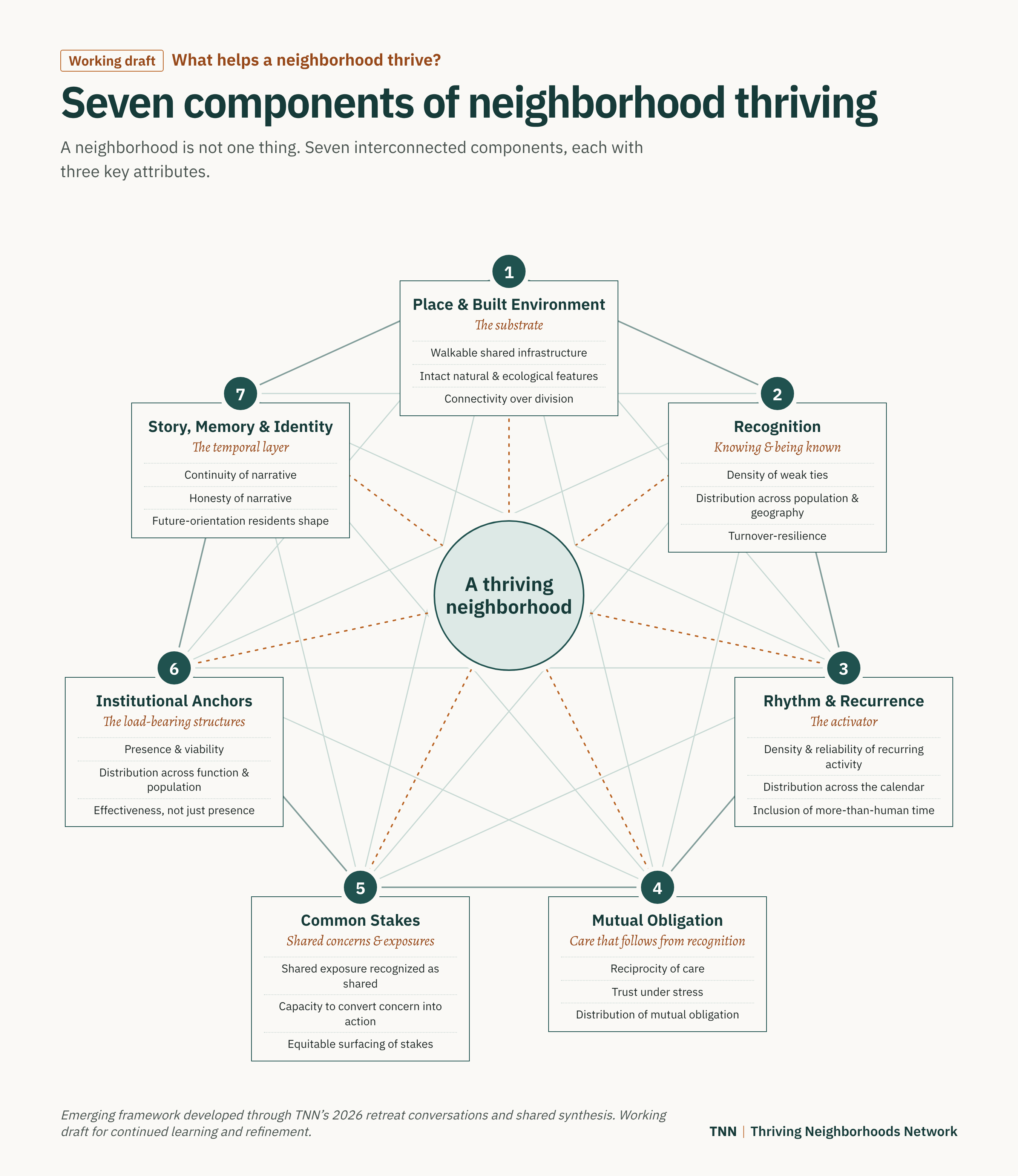
A neighborhood is not one thing. This emerging framework names seven interconnected components, each with three key attributes. Select a component to explore it.
1Place & Built EnvironmentThe substrate
The physical and ecological stage on which the neighborhood exists: geography, infrastructure, watershed, canopy. Necessary but not sufficient.
Key attributes
- Walkable shared infrastructureSidewalks, third places, transit that put people in contact on foot.
- Intactness of natural & ecological featuresWatershed condition, canopy, green space, absence of active degradation.
- Connectivity over divisionBridging features outweigh dividing ones. The same infrastructure can do either.
2RecognitionKnowing & being known
The texture of being a recognizable person in a recognizable place. The on-ramp to every deeper relational component.
Key attributes
- Density of weak tiesHow many neighbors a typical resident can name and be named by.
- Distribution across population & geographyWhether recognition is broadly shared or hides exclusion behind a healthy average.
- Turnover-resilienceWhether recognition rebuilds as residents move in and out, or collapses.
3Rhythm & RecurrenceThe activator
The cadence of repeated encounter over time: daily routines, weekly rituals, seasonal gatherings, and the more-than-human time of the place itself.
Key attributes
- Density & reliability of recurring activityHow often, and how dependably, neighbors are placed in repeated contact.
- Distribution across the calendarRhythms spread across seasons and time scales: weekly, monthly, annual.
- Inclusion of more-than-human timeSeasonal markers, phenology, the rhythm of the land held in shared awareness.
4Mutual ObligationCare that follows from recognition
What recognition becomes when activated by trust and reciprocity. The fabric of bilateral care that turns acquaintance into shared responsibility.
Key attributes
- Reciprocity of careCare that flows in both directions, not only one. Trust lives here.
- Trust under stressWhether obligation holds when something tests it. Diagnostic under load.
- Distribution of mutual obligationWho is included in care networks, and who is not.
5Common StakesShared concerns & exposures
The conditions and risks residents share simply by living in the same place, whether they chose to or not. Visible most clearly when stress reveals them.
Key attributes
- Shared exposure recognized as sharedResidents see the conditions they share as common, not just personal.
- Capacity to convert concern into actionShared concern produces shared response, not only shared complaint.
- Equitable surfacing of stakesWhose concerns get named publicly, and whose do not.
6Institutional AnchorsThe load-bearing structures
The formal and informal structures that hold material and relational life together across time: schools, congregations, libraries, businesses, mutual aid.
Key attributes
- Presence & viabilityAnchor institutions exist and are alive: financially, participatorily.
- Distribution across function & populationCoverage spans the range of functions and the range of people served.
- Effectiveness, not just presenceInstitutions actually anchor: hosting gatherings, generating activity, rather than existing as shells.
7Story, Memory & IdentityThe temporal layer
The layering of past and future that makes a neighborhood accountable to both. What is honored, what is reckoned with, what is being built toward.
Key attributes
- Continuity of narrativeHistory is held and passed on, not lost to turnover or development.
- Honesty of narrativeDifficult history is named publicly: redlining, displacement, Indigenous dispossession.
- Future-orientation residents shapeArticulated visions for the place’s future, held by the people who live there.
How the seven work together
The components are not independent. Place is the substrate. Recognition is what proximity can produce given rhythm. Mutual obligation is what recognition becomes when activated by trust. Common stakes are conditions residents share whether they recognize each other or not. Institutions hold material and relational life across time. Story makes the whole accountable to past and future.
Conditions that cut across all seven
- The more-than-human shows up across place, rhythm, and story rather than as a separate component.
- The boundary question (whose “we,” and who are we responsible to?) applies to all seven.
- Geography excludes and relationship includes; the asymmetry has to be held with intentionality.
- Measurement captures what is currently activated; cultivation works on what is latent.
View the one-page poster · Download
Emerging framework developed through TNN’s 2026 retreat conversations and shared synthesis. Working draft for continued learning and refinement.